E-invoicing?
We make it
simple.
Since 1 January 2025, every business in Germany has been required to receive and process e-invoices – no exceptions. We explain what that means and show you how to put it into practice with Odoo.
Sending e-invoices is being introduced in two stages:
1. From 1 January 2027, mandatory for businesses with a previous-year turnover of more than 800,000 Euro.
2. From 1 January 2028, mandatory for all businesses.

What is an e-invoice?
An E-Rechnung is an invoice issued, transmitted and received in a structured, machine-readable format. The invoice data sits in fixed fields, not in running text. Your software can process that data directly, without anyone retyping amounts, line items and account assignments. The format has to conform to the European standard EN 16931.
For industry, wholesale, logistics, manufacturing and services this touches two processes: incoming invoices and your own invoicing.
A PDF invoice contains the same information, but not in structured form. Your software cannot process it automatically. A PDF sent by email also remains a sonstige Rechnung – the legal term for a paper or unstructured invoice – just like paper.
Receiving or sending
what applies when?
For your business, these are two processes with two deadlines. You have already been required to receive e-invoices since 1 January 2025. Sending is subject to a transition period that runs in two stages until 1 January 2028.
It’s worth making the distinction so that you can take the right steps by the right date, depending on your processes. Receiving concerns your incoming invoices – in other words, what happens when a supplier sends you an XML file. Sending concerns your outgoing invoices, and therefore your invoicing. Two different processes, two different deadlines.
Since 1 January 2025: Receive and process.
Every business in Germany must be able to accept e-invoices and process them electronically. There are no exceptions.
Until 31 December 2026: Other invoice formats remain permitted.
During this period, anyone issuing invoices may continue to send them in other formats. Paper is fine without restriction; a PDF only if the recipient agrees to it.From 1 January 2027: Sending applies above 800,000 Euro previous-year turnover.
Businesses with a previous-year turnover of more than 800,000 Euro issue their domestic B2B invoices as e-invoices.Until 31 December 2027: One extra year at 800,000 Euro or less.
If your previous-year turnover is 800,000 Euro or less, other invoice formats remain permitted for another year, under the same condition: paper without restriction, a PDF only with the recipient’s consent.From 1 January 2028: Sending applies to all remaining businesses.
From then on, all businesses issue invoices to business customers in Germany electronically. Small businesses under the VAT small business scheme are still not required to issue e-invoices.
The transition period for sending runs until 31 December 2026. The next deadline is 1 January 2027. The obligation to receive already applies.
Until then, you may continue to send paper invoices, and PDF invoices only with the recipient’s consent. The obligation only applies to invoices between businesses in Germany, not to invoices to private customers. Your tax adviser is best placed to clarify exactly which turnover counts.
Are there any exceptions?
The deadlines apply to invoices between businesses in Germany (B2B). There are exceptions for sending, for example for small businesses. There are none for receiving.
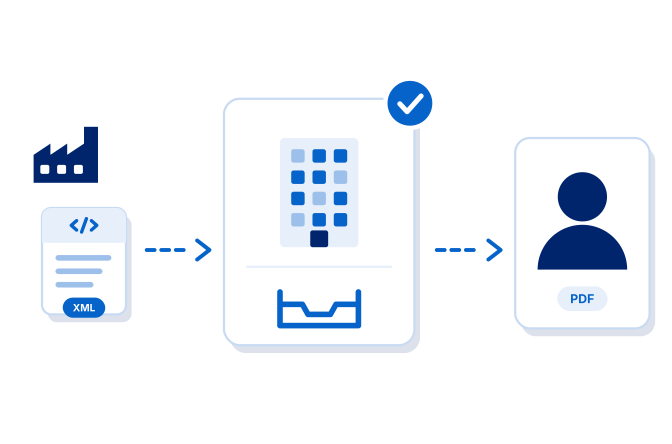
Small businesses under the VAT small business scheme don’t have to issue e-invoices. They must still be able to receive and process them, however.
Even businesses that cannot reclaim input VAT must accept e-invoices. The Federal Ministry of Finance explicitly names medical practices in this context. Your practice therefore needs a way to receive and process e-invoices from suppliers.
The e-invoicing mandate only covers transactions between businesses in Germany. Invoices to private customers are not included. Even businesses that mainly invoice consumers still need to be able to receive supplier invoices.
Key dates at a glance.
Which sending deadline applies depends on your previous-year turnover.
Your tax adviser can clarify this for you.
Receiving e-invoices: since 1 Jan 2025
Transition period: until 31 Dec 2026
Sending e-invoices with >€800,000 previous-year turnover: from 1 Jan 2027
Sending e-invoices for all: from 1 Jan 2028
Want to know where your system stands today?
We’ll look at your incoming and outgoing invoices and tell you what’s missing.
ZUGFeRD, XRechnung, Peppol – what’s what?
ZUGFeRD and XRechnung are formats. Peppol is a transport network.
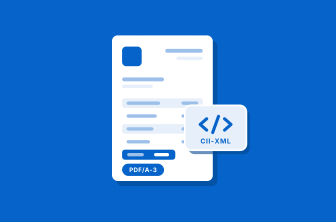
ZUGFeRD
A hybrid format: a PDF with embedded CII XML. Your recipient sees the familiar invoice, while their software reads the XML inside it.
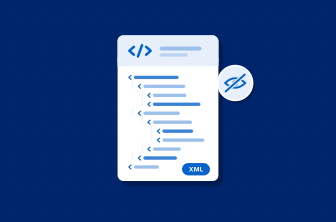
XRechnung
Pure XML with no visual representation. For invoices to the German federal government, XRechnung is the mandatory standard for electronic invoicing.
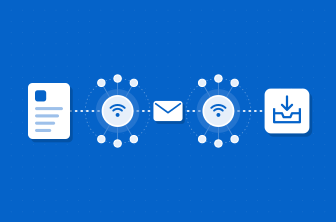
Peppol
Peppol transmits invoices in the Peppol BIS Billing 3.0 format, a UBL-based format compliant with EN 16931.
Which format suits you?
That depends on who receives your invoices. If some of your customers process invoices automatically while others still read them on screen, ZUGFeRD is usually the right choice. The PDF stays readable, and the invoice data is embedded in it as an XML file.
If you also invoice public-sector clients (B2G, business-to-government), there’s no way around XRechnung – it’s the mandatory standard for the federal government. That said, you don’t have to commit to one. EN 16931 allows two XML formats, CII and UBL – and ZUGFeRD is based on CII. In the EN 16931 profile, a ZUGFeRD invoice is therefore largely equivalent to an XRechnung for B2B transactions.
For the public sector, however, that isn’t always enough. XRechnung is the German implementation of EN 16931 (CIUS, Core Invoice Usage Specification) and adds numerous national business rules to the standard. To cover this, ZUGFeRD has its own profile called XRechnung. If you can generate both formats, both routes remain open to you.
E-invoicing with Odoo.
Formats, deadlines and incoming invoices all come together in the system you already use for invoicing. In most cases, you won’t need any new software.
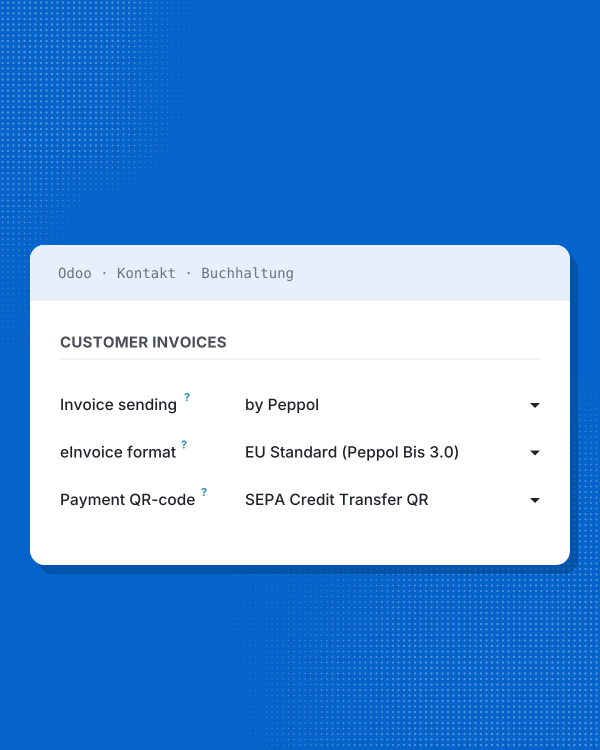
Formats, deadlines and incoming invoices all come together in the system you already use for invoicing. In most cases, you won’t need any new software. If you already invoice in Odoo ERP, the e-invoice is generated from the process you go through anyway: quotation, order, invoice. Odoo Enterprise 19 supports ZUGFeRD and XRechnung. Peppol BIS Billing 3.0 runs via the Peppol network – in other words, via the transport route rather than as an additional format.
For us, this is usually a matter of configuration, not development: generally no code and no extra software. That keeps the switchover simple. We set the format for each invoice recipient, check your master data and set up incoming invoice processing so that XML files don’t sit unread in an inbox but go straight to your accounting.
Incoming and outgoing invoices stay in the same system, with no manual hand-offs in between. Handover to your tax adviser runs via the Odoo DATEV interface: depending on your use case, posting data as well as customer and supplier master data can be exported and passed on to their firm.
As an Odoo Gold Partner, we set this up together with you. We understand SMEs. And we see ourselves not just as a service provider, but as a true partner. Discover what else the system has to offer in our Odoo solutions.
Odoo and DATEV.
Odoo ERP and our DATEV interfaces at a glance.
Odoo Business Suite
All-in-One-ERP, implemented by ODION as an Odoo Gold Partner
In Odoo, sales, purchasing, warehousing, production and accounting all work in a single system – with no interfaces between isolated solutions. You enter data once, and it’s immediately available across every department. Odoo grows with your business, with no need to switch systems. As an Odoo Gold Partner, we take care of analysis, set-up and training – and connect Odoo directly to DATEV.
Odoo for DATEV Unternehmen online
Integration, compatible with Odoo 17-19
Integrate DATEV Unternehmen online directly into Odoo – without the need for file transfers. Odoo’s direct integration with DATEV Unternehmen online eliminates the need for files. Accounting and document data are transmitted directly online to your tax adviser. Take advantage of real-time data transfer and minimise manual data entry.
Odoo CSV Export for DATEV Kanzleirechnungswesen
Export in CSV/EXTF format, compatible with Odoo 15-19
Discover the Odoo CSV module for DATEV – the perfect solution for seamless integration of your financial accounting. Optimise your processes, automate book entries and reduce manual errors. With our Odoo module, you’ll always have a clear overview and save valuable time.
Success Stories.



What you can do now
The first step is a check: can you already receive and process e-invoices today?
This has been required since 1 January 2025.
The next steps, in order:
Check your incoming invoices: Find out where incoming XML invoices currently end up and who sees them. That way, no e-invoice goes unnoticed in an inbox.
Check your ERP system: Often, all that’s missing is the right setting. Check what your ERP system can already do and what can be configured with little effort.
Confirm your deadline: When you need to start sending e-invoices depends on your previous-year turnover: above 800,000 Euro, it’s 1 January 2027; otherwise, 1 January 2028. Special rules apply to small businesses – your tax adviser knows your situation.
Agree on a format: Talk to your most important invoice recipients before choosing between ZUGFeRD and XRechnung. That way, the format fits from the start.
Test with real documents: Send a test invoice and check with the recipient that all the data arrives complete. That way, errors come to light before real payments are at stake.
The key facts
at a glance.

No. A PDF invoice counts as an “other invoice”, even if you send it by email. An e-invoice requires a structured format that complies with EN 16931, such as XRechnung or ZUGFeRD.
Yes. All businesses have been required to receive e-invoices since 2025. Businesses with a previous-year turnover of 800,000 Euro or less must also issue them from 2028. Small businesses under the VAT small business scheme are exempt from the obligation to issue e-invoices.
Any format that complies with the EN 16931 standard is permitted. In Germany, this mainly means XRechnung and ZUGFeRD from version 2.0.1 onwards, excluding the MINIMUM and BASIC-WL profiles.
Yes. Out of the box, Odoo creates e-invoices in Factur-X (ZUGFeRD) and XRechnung format and sends them via Peppol. Invoices received via Peppol are automatically created in Odoo as drafts.